The Card Catalog of Goodwill: Inside the Borrowing System Stanley Kubi Built One Garage at a Time
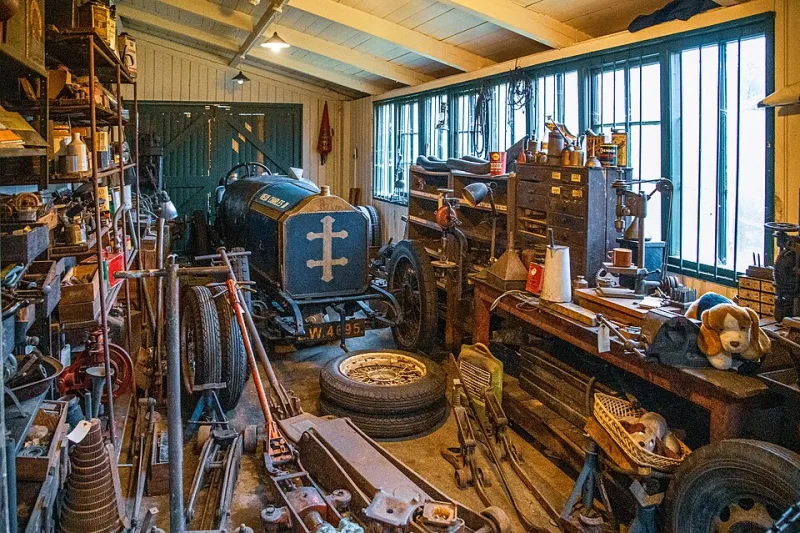
Photo: Michael Gaylard, CC BY 4.0, via Wikimedia Commons
The garage on Delmore Avenue does not look like a public institution. There is no signage, no hours posted on the door, no nonprofit letterhead anywhere in sight. And yet, according to a weathered recipe box on the workbench, more than 300 households have drawn on its inventory since the early 1980s.
Stanley Kubi ran what archivists might call a distributed lending library and what neighbors simply called "the garage." Inside: a socket set organized by size, a floor sander that had refinished half the hardwood in the school district, a post-hole digger, two ladders, and a tile saw that had, by one account, "done every bathroom on the east side."
The Ledger That Kept Itself
Stanley's system was elegant in its simplicity. A shoebox held index cards, one per tool. When you borrowed something, you wrote your name and the date. When you returned it, you crossed yourself off. There were no deposits, no late fees, and—remarkably—no enforcement mechanism beyond reputation.
"He used to say the card box was the most honest place in town," recalls Marlene Ostrowski, who borrowed a pressure washer every spring for eleven years. "And the funny thing is, he was right. I don't think anything ever went missing. Not once."
His daughter, Diane Kubi-Ruiz, found the box intact after her father's passing, along with a hand-drawn chart mapping which neighbors owned which tools, in case the garage couldn't meet a request. "He wasn't just lending his own things," she says. "He was a switchboard. He knew who had a rototiller three streets over and whether they'd be home on a Saturday."
An Institution Without a Name
What Stanley built anticipates, by decades, the formal tool-lending libraries that have sprouted in public libraries and community centers across the country. But where those operations require memberships and liability waivers, Stanley's ran on something harder to legislate: mutual familiarity.
The ledgers double as an accidental social history of the town. Weddings appear as one-time borrowings of a folding-table set. New parents show up for a reciprocating saw in March and a stroller-repair kit in June. The same surnames recur across forty years, children's handwriting eventually replacing their parents'.
"You can watch the neighborhood turn over in those cards," says Tom Vercek, a retired machinist who still borrows Stanley's pipe wrench. "Names change. The habit doesn't."
The Question on Delmore Avenue
Since the funeral, Diane and her brother have faced a practical dilemma: the garage, the tools, the card box—keep it running, or let it rest with him?
The neighbors have made their preference clear. A petition at the hardware store gathered 140 signatures in two weeks. Someone laminated a copy of the borrowing instructions and taped it inside the garage door. The tile saw, notably, has not stopped moving.
"Dad never called it a legacy," Diane says. "He called it Tuesday." But the family is leaning toward keeping the garage open, perhaps under the stewardship of a rotating group of neighbors, with the card box preserved exactly as he left it.
What the Box Teaches Us
There is a lesson in that shoebox that extends well past Delmore Avenue. Communities do not only run on formal infrastructure—budgets, ordinances, capital projects. They run on informal systems of trust, often invisible until the person who maintained them is gone.
Stanley Kubi's garage was never on any map. It did not need to be. Everyone who needed it already knew the way.