Twelve Photographs, One Life: A Visual Remembrance of Stanley Kubi
Photo: Fitindia, CC BY-SA 4.0, via Wikimedia Commons
Some lives are best told in paragraphs. Stanley Kubi's is told just as well in pictures — the kind that curl at the edges, the kind found in shoeboxes labeled in pencil. His family recently opened those albums to us, along with snapshots borrowed from neighbors and the local historical society. What follows is his story, one frame at a time.
The Mill Town Boy
Photograph 1: A boy on a gravel road, circa 1948.
The earliest image shows Stanley at about six years old, squinting into a Midwestern summer, standing on the gravel road that served the mill workers' row houses. His father worked the shift schedule; his mother kept a garden that fed the family through winter. "He never talked about being poor," his cousin Ruth recalls. "He talked about being busy. Everybody had something to fix or grow."
Photograph 2: The schoolhouse portrait, 1954.
A formal school photo, collar slightly askew. Teachers' notes in the margins of his report cards — borrowed from the district archive — mention a boy who "assists younger students without being asked."
Young Hands, Learning Trades
Photograph 3: The bicycle, 1958.
Stanley, twelve, stands beside a rusted bike he is mid-way through rebuilding. Family legend holds that this was the first machine he ever took apart entirely. It would not be the last.
Photograph 4: The mill in the background, 1962.
A summer job at the mill put a pay stub in his pocket and a lifelong respect for working hands. Former coworkers remember a teenager who watched the older machinists more than he talked.
Service, Family, and the Years That Follow
Photograph 5: The uniform, 1966.
Stanley served two years in the Army, stationed stateside. The photo shows a young man in dress uniform outside his parents' house. He rarely spoke of the service itself, but kept in touch with his unit's reunion group for decades.
Photograph 6: The wedding, 1969.
Stanley and his wife, Elaine, on the steps of St. Adalbert's. Guests recall the reception lasted until the church hall lights were shut off.
Photograph 7: The backyard, 1974.
Two children, a swing set Stanley built from pipe stock, and a workbench already visible at the frame's edge. His daughter calls this "the most honest picture of my father — always half-turned toward whatever needed doing."
The Neighborhood Years
Photograph 8: The driveway workshop, 1981.
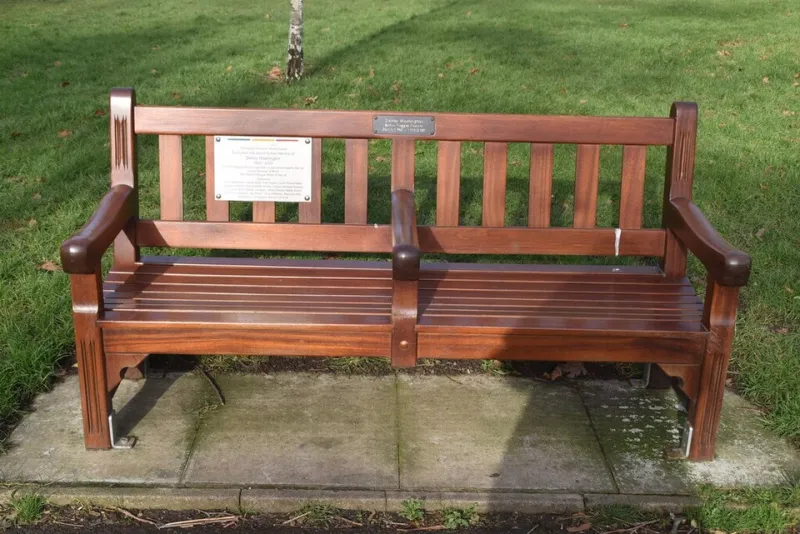
Perhaps the most reproduced image at the memorial bench: Stanley at his driveway bench, three neighbor children leaning in, tools in small hands. It was taken by a passing mail carrier who became a lifelong friend.
Photograph 9: The Fourth of July block party, 1989.
Stanley at a grill, apron on, surrounded by what the caption in his wife's handwriting calls "the whole street."
Photograph 10: The hardware store counter, 1996.
After retiring, Stanley worked part-time at the local hardware store, a job his family says he treated as a second community center. "He mostly gave directions to people's houses and advice about washers," the store's owner remembers.
Photograph 11: The porch, 2008.
Elaine and Stanley on their porch swing, both laughing at something out of frame. Friends say this is how they should remember him — mid-laugh, unhurried.
Photograph 12: The bench, 2019.
The final image in the collection is not of Stanley at all. It is the memorial bench, freshly installed, with flowers left by strangers. His grandson took the picture the morning after the dedication.
A Portrait Completed
Viewed together, the twelve photographs trace a familiar American arc — mill town, military service, marriage, work, porch — but they also reveal something less common: a man whose center of gravity was always slightly outside himself, toward whoever stood nearby holding the other end of a two-by-four.
The family has placed copies of the full collection in the community room at the public library, where anyone may view them. As Ruth put it, "He belonged to everybody. The pictures should, too."