What Arrived After: The Letters, Cards, and Voicemails That Found Stanley Kubi's Family
Photo: Chuck Schultz from Anniston, AL, USA, CC BY-SA 2.0, via Wikimedia Commons
The first envelope arrived eleven days after the funeral. Stanley Kubi's daughter, Marlene, almost set it aside — the return address was unfamiliar, a postmark from Tucson, Arizona, a place she had no reason to connect with her father's ninety-one years in Ohio.
Inside was a single handwritten page. The writer, a woman named Ruth, explained that Stanley had been her supervisor at a grain elevator in the summer of 1968, and that when her husband left, Stanley had quietly rearranged her shifts so she could keep her job. She had never thanked him properly. She was thanking him now.
A Mailbox That Kept Filling
Ruth's letter was not an anomaly. Over the following eight months, the Kubi family received more than two hundred pieces of correspondence — cards, letters, printed photographs, and, in one memorable case, a cassette tape mailed from a retirement community in Florida. Marlene and her brother David began keeping them in a shoebox, then a second shoebox, then a file box with alphabetical dividers.
"We thought the funeral was the ending," Marlene says. "It turns out it was just the moment people started talking."
The correspondence came in waves. The first wave, predictably, came from those closest to him — neighbors, fellow parishioners, the men from his Thursday morning coffee group at the diner on Route 20. But the second and third waves surprised the family: former students Stanley had tutored at the library, a mail carrier he'd greeted every morning for twenty years, a young man who once worked the register at the hardware store and remembered that Stanley always asked about his mother's health.
What People Say When It's Too Late to Say It in Person
Reading through the archive — and the family has generously allowed portions of it to be shared — certain patterns emerge. Almost nobody writes about Stanley's accomplishments. There are no references to promotions, awards, or milestones. Instead, the letters fixate on the smallest possible interactions.
A man from Fort Wayne, Indiana, writes about the time Stanley stayed an extra hour to help him jump-start a truck battery in the church parking lot in 1994. A woman recalls that Stanley remembered her daughter's name after meeting her exactly once. Someone signing only "the Hendersons' grandson" describes how Stanley taught him to sharpen a lawnmower blade over a single Saturday afternoon.
The letters also reveal something about the writers themselves. Many open with an apology — I know you may not remember me — as though the writers assume their brief encounters couldn't possibly have registered. Others confess that they'd meant to reach out for years, that Stanley had crossed their mind at odd moments, and that his passing converted a vague intention into a stamp and an envelope.
The Voicemail No One Deleted
The Florida cassette was eventually transcribed for the family: a ninety-second recording from a man named Earl, who sang two bars of an old hymn, explained that Stanley had once driven him to a dialysis appointment three towns over, and then simply said, "Well, that's all I called to say," before the tape ran out.
It's the ending that stays with the family. Not a grand summation. Just that's all I called to say — as though a ride to dialysis were an ordinary thing, unworthy of ceremony.
And perhaps that is the archive's central revelation. The letters don't describe a remarkable man. They describe an ordinary man whose ordinary kindnesses, multiplied across nine decades, produced a remarkable effect. Nobody wrote to say Stanley changed their life. Dozens of people wrote to say he changed an afternoon.
An Open Invitation
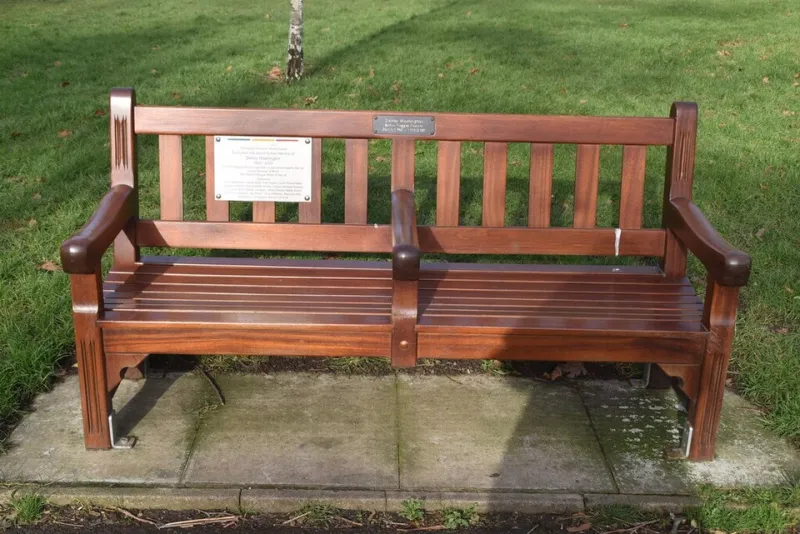
The Kubi family has placed a selection of these letters — with permission from the senders — in the community binder kept at the memorial bench, so that visitors can read Ruth's letter from Tucson or the Hendersons' grandson's memory of the lawnmower blade.
If Stanley Kubi touched your life in some small way, the family would be glad to add your words to the collection. Written correspondence may be directed through the contact page of this site. It seems safe to say there's room in the file box. And it seems even safer to say that Stanley, who never met a stranger and never hurried a conversation, would have answered every last one of them.